Application 2026/2587 proposes 408 homes on Green Belt land at Hersham Village Golf Club. Residents have until 28 December 2026 to comment. The council’s register currently shows the decision being taken by a planning officer, with no Planning Committee date.
Elmbridge planning register checked: 25 November 2026. This article also draws on the application form, Planning Statement, covering letter and landscape documents supplied for review. Transport figures below are the applicant’s estimates and reported counts.
Key facts
- Application: 2026/2587, submitted to Elmbridge Borough Council by Claudel Venture Holdings Ltd.
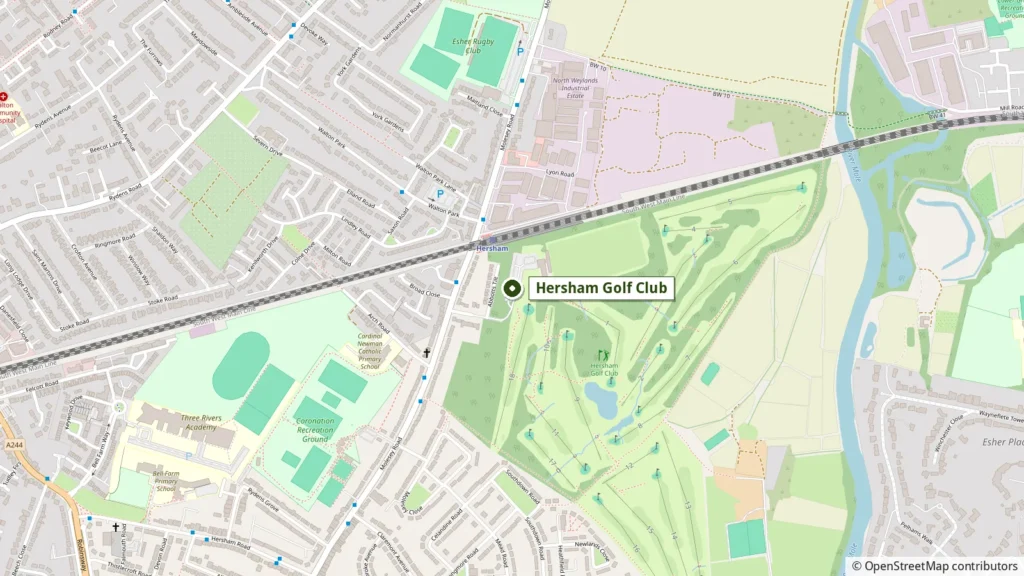
- What: 408 homes (406 net, after two houses are demolished) on Green Belt land at Hersham Village Golf Club, Assher Road, Hersham.
- Comments close: 28 December 2026.
- How to comment: through Elmbridge’s online form, quoting 2026/2587. Anyone can comment.
- Who decides: the register showed an officer delegated decision, with no Planning Committee date, when checked on 25 November 2026. This can change.
- Target decision date: 19 February 2027.
- Affordable homes: the applicant says 206 (50.5%). No officer report has been published yet.
Comments close on 28 December 2026
Consultation on application 2026/2587 opened on 23 November 2026 and comments close on 28 December 2026. That window runs across Christmas, so it is worth acting early.









Comment on application 2026/2587 using Elmbridge’s online form
The register shows around 170 neighbour addresses notified, across Assher Road, Molesey Road, Southdown Road, Molesey Close and Abbotts Tilt, along with 33 statutory consultees. When we checked on 25 November 2026, no comments had been received. How to comment, and what makes a comment count, is set out next.
How do I comment on or object to application 2026/2587?
Comments on a planning application go to Elmbridge Borough Council. They do not go to the applicant, and they do not go to us. The council’s deadline is 28 December 2026.
Open Elmbridge’s comment form for application 2026/2587
Quote the reference 2026/2587 in anything you send, including emails and letters to councillors.
You do not need to have had a letter
Around 170 addresses were notified directly, but anyone can comment. If you live elsewhere in Hersham and use Molesey Road, the station or the local schools and surgeries, your comment is as valid as one from Assher Road.
You can support it as well as object
Some residents will think 408 homes, around half of them affordable on the applicant’s figures, is what the area needs. Others will think this is the wrong land or the wrong scale. This page sets out the facts so that you can reach your own view, and we are not going to tell you what to write.
What makes a comment count
Planning decisions turn on what are called material planning considerations. A comment that addresses one of them has to be weighed. A comment that rests on something else carries no weight, however strongly felt.
These are material:
- Green Belt policy, and whether the harm to the Green Belt is outweighed by the benefits
- highway safety, traffic and access, including the Assher Road and Molesey Road accesses
- parking
- design, scale, height, density and layout
- loss of open space and the effect on the character of the village
- trees, ecology and biodiversity
- drainage and flood risk
- noise and disturbance, including during construction
- overlooking, privacy and loss of light
- the capacity of local infrastructure such as schools, GP services, drainage and utilities
- the cumulative effect alongside other local schemes
These are not material:
- loss of a private view
- the effect on property values
- boundary or ownership disputes
- competition with an existing business
- the identity, motives or profits of the applicant
- matters controlled by other legislation, such as building regulations
A short, specific comment about one material issue you know at first hand carries more weight than a long general objection. If you walk the Assher Road virtual footway with a pushchair every morning, or you have watched a particular stretch of road flood, say so and say where. Write it in your own words. Identical copied text tends to be counted as a single representation, however many people send it.
Asking for the Planning Committee to decide
The register currently shows this application down for a decision by an officer under delegated powers, as the next section explains.
Many residents will remember the old route: ask a ward councillor to call the application in, and it went to the Planning Committee. That route no longer exists. It was removed on 31 October 2026 by the Town and Country Planning (Discharge of Local Planning Authority Functions) (England) Regulations 2026 (SI 2026/854), three weeks before consultation on this application opened.
Under the new national rules, a major application like this one is decided by an officer unless two people agree to send it to committee: a councillor nominated by the council for that purpose (the nominated member) and a nominated officer. They may refer it if, in their view, it raises an issue of economic, social or environmental significance to the local area, or a significant planning matter having regard to the development plan. That is the gateway test. Nothing in the regulations sends an application to committee because of the number of objections received, however many there are.
You can still write to your ward councillors. Be clear about what you are asking for. A ward councillor cannot call this application in. What you can ask is that they press for 2026/2587 to be referred to the Planning Committee under the gateway test, and that they tell you who Elmbridge’s nominated member and nominated officer are and how the test is being applied. We do not know how Elmbridge is operating it in practice, because we have not established that. Your councillor is the right person to ask.
The wards notified of the application are Hersham Village Ward and Esher Ward. Councillors’ contact details are on the Elmbridge Borough Council website.
None of this makes commenting on the application less worthwhile. Your comment goes on the file, the case officer has to weigh it if it raises a material consideration, and the representations on the file are part of the context in which the nominated member and officer judge whether the gateway test is met.
Writing to the MP
Monica Harding has been the Liberal Democrat MP for Esher and Walton, which includes Hersham, since the general election of 4 July 2024.
An MP does not decide planning applications and cannot overrule the council. The House of Commons Library puts it this way: “MPs do not have any formal role in the planning process”, and comments “are considered equally on their merits regardless of who makes them”. The only person who can take an application out of a council’s hands is the Secretary of State, using the call-in power in section 77 of the Town and Country Planning Act 1990, and generally only where “planning issues of more than local importance are involved”. Anyone can ask for that. A request from an MP has no special status. Ms Harding’s own published FAQ says she “cannot assist with matters outside my remit, including planning issues”.
She has, though, raised the delegation change itself. She wrote to the Secretary of State in late July 2026. The published letter, dated 29 July 2026, says that “the longstanding right of ward councillors to call in applications for committee scrutiny is being removed entirely” and that “there is no provision for referral on the basis of public objections, and no role for ward members in calling in cases they believe warrant democratic scrutiny”. The same letter says: “I am not arguing against development. Our area needs homes.”
She returned to it in the Commons on 7 September 2026, in a question on Green Belt planning policy in Esher and Walton:
“The Government changes to planning rules are of considerable concern to my constituents and are leading to speculative applications everywhere. Theoretically, the changes could mean that the whole of my constituency, which is 50% green belt and has seven stations, will be concreted over. My constituents are certainly not opposed to growth or house building, but they do not want to be ignored. The long-standing right of councillors to call in applications has been removed, which runs counter to the new Prime Minister’s values on devolution. That is why I wrote to the Secretary of State on 28 July. I have not had a reply to my question, so will she meet me to answer these questions directly?”
The minister replying named Hersham:
“I fully appreciate the hon. Lady’s concerns about inappropriate development around stations, such as Hersham and Claygate in her constituency. It is right that we seek to promote good development around well-connected stations, outside of settlements or on green-belt land, as those are some of the most sustainable locations for new homes in the country. However, the new NPPF makes clear that development proposals around such stations should not prejudice any proposals for long-term comprehensive development in the same location, and must also be of a scale that can be accommodated, taking into account existing or proposed availability of infrastructure.”
That last clause is worth noting for anyone commenting on 2026/2587. The Government’s own stated position is that development near a station must be of a scale that existing or proposed infrastructure can accommodate.
Her recorded votes on the legislation behind the change are as follows. She voted against the Planning and Infrastructure Bill at Second Reading on 24 March 2025 and at Third Reading on 10 June 2025. On 13 November 2025 she voted against the Government’s motion to disagree with Lords Amendment 33 to the Bill. On the deferred division of 8 July 2026 that approved the regulations themselves, Division 53, no vote is recorded for her. Not voting in a deferred division does not indicate support or opposition. Members miss divisions for many reasons, and we have found no explanation for this one. A constituent who wants to know can ask her.
What this means in practice: writing to the MP about application 2026/2587 will not change the decision on it. Writing to her about the national rules that now settle who takes that decision might achieve something, because national policy is the part an MP can act on, and she is already on the record about it. Her parliamentary email is monica.harding.mp@parliament.uk. MPs can only take up matters for their own constituents, so include your address.
As it stands, an officer will decide this, not the Planning Committee
The Elmbridge register lists application 2026/2587 for an officer delegated decision. No committee date is set. The target decision date is 19 February 2027 and the case officer is Aneta Mantio.
Put plainly, a 408-home scheme on Green Belt land is presently due to be decided by a planning officer under delegated powers, and not by elected councillors sitting in public on the Planning Committee. The earlier 221-home scheme on the same land did go to the committee, as set out further down this page.
That statement has limits. It is what the register showed when we checked on 25 November 2026. The decision route can change before a decision is made.
A national scheme of delegation came into force on 31 October 2026 under the Town and Country Planning (Discharge of Local Planning Authority Functions) (England) Regulations 2026. Under those rules a major application is delegated to officers by default, and reaches committee only if the council’s nominated member and nominated officer agree to refer it. The right of a ward councillor to call an application in has gone. What the register shows for 2026/2587 is what that default would produce. We have not asked Elmbridge to confirm how the route was set for this application or whether a referral has been considered, and residents may want to ask. The section above explains what can and cannot now be done.
Officers decide most planning applications, and a delegated decision is still made against the same policies with a written report. The difference is that there is no public meeting, no vote by councillors and no opportunity to address the committee. For a proposal of this size, on this land, that is a difference residents are entitled to know about while the comment period is still open.
What is proposed?
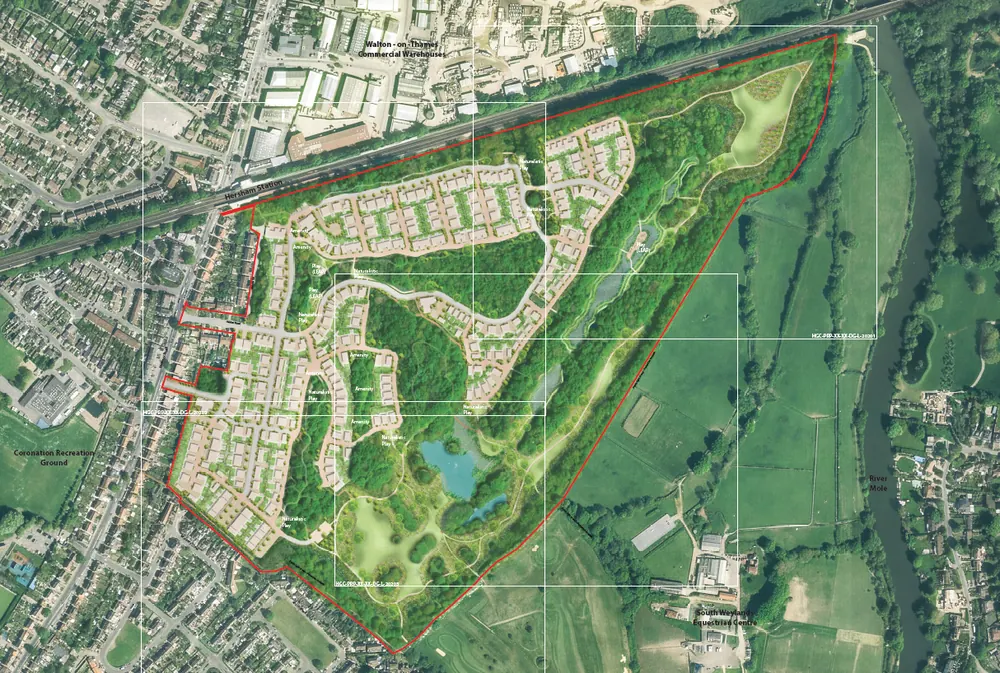
Claudel Venture Holdings Ltd proposes 408 homes, a café, play spaces, landscaping and Suitable Accessible Natural Greenspace (SANG). The register description gives 408 dwellings. Two existing dwellings would be demolished, so the net increase is 406. That last figure is subtraction: 408 gross, 2 demolished, 406 net. [1, pp4 and 14; 4]
The applicant says 206 of the homes would be affordable, which it puts at 50.5% of the total, with 202 for private sale. Those figures come from the applicant’s covering letter and Planning Statement. They are not a council finding. No officer report or consultee response has been published yet, so nobody independent of the applicant has assessed the tenure mix, or how it would be secured. [2, p54; 3]
There is no EIA screening or scoping opinion for this application. The applicant has submitted a voluntary Environmental Statement. Its scope was set against the consented scheme and agreed with Elmbridge at a pre-application meeting on 2 July 2026.
Two homes on Molesey Road would be demolished
The scheme has two vehicle accesses, the existing one from Assher Road and a new one from Molesey Road. To create the second, the application proposes demolishing two existing houses, 274 and 276 Molesey Road, and running a secondary access through the gap.
Neither house belongs to the applicant. They are in separate ownership, and a Certificate B notice was served on 21 October 2026. That is the formal notice an applicant must give when it applies for permission on land it does not own. It tells us the owners have been notified. It does not tell us whether they have agreed to sell.
For neighbours, this changes the street as well as the site behind it. Two house plots on Molesey Road would become a road junction. The secondary access is also central to the applicant’s transport case, discussed below, because it is said to take development traffic away from Assher Road. [1, p4; 4]
The earlier permission on the same land
An earlier scheme for 221 homes, application 2023/3519, already has permission. The Planning Committee resolved to grant it on 3 November 2025, and permission was issued on 12 June 2026 following completion of the section 106 agreement on 11 June 2026.
The new application is for the same land. The 221 and the 408 are alternatives and must not be added together. What the comparison does show is the scale of the change now sought: 187 more homes than the scheme councillors considered.
What do the traffic figures say?
The Planning Statement reports an estimated 158 two-way vehicle trips between 08:00 and 09:00, and 160 between 17:00 and 18:00. Two-way trips count vehicle movements arriving and leaving, rather than individual households or a full day’s journeys. The statement compares these with reported existing two-way Molesey Road flows of 1,314 vehicles in the morning peak and 1,222 in the evening peak. Those comparisons produce approximately 12% and 13%. [2, p105, paragraph 11.95]
These figures need careful handling. The summary does not reproduce the traffic assignment showing which movements use each access and road section. Dividing all development trips by a Molesey Road count is not, by itself, proof that every section of that road would see the same percentage increase. Nor does a percentage traffic increase establish the resulting queue or delay.
The applicant argues that affordable housing and access to the station, buses and walking routes could make actual vehicle trips lower. It also says the secondary access would reduce the volume of development traffic using Assher Road. The reviewed summary does not quantify those further reductions or provide the split between the two accesses. [2, p105, paragraphs 11.96-11.98]
What does the junction modelling cover?
The applicant says classified turning counts, queue surveys, automatic traffic counts and walking and cycling surveys informed its assessment. Its Planning Statement reports PICADY modelling for 2033, concluding that the Molesey Road/Assher Road junction and the proposed secondary-access junction would operate well within capacity in both peaks. [2, pp106-107, paragraphs 11.100-11.101]
That is a conclusion about two named access junctions. The statement does not reproduce the numerical queues, delays or capacity results, survey dates, background-growth factors or committed-development schedule. The underlying Transport Assessment and its appendices are needed to check the assumptions and establish what wider-network assessment was undertaken. Their absence from this summary does not prove they were omitted from the technical work.
What does the applicant say about walking on Assher Road?
The Planning Statement does not claim that every operational transport effect is insignificant. It identifies one significant adverse effect for users of the virtual footway on Assher Road, explaining that pedestrians and vehicles share the carriageway. It cites proposed mitigation and says no further proportionate measures have been identified. [2, p107, paragraphs 11.104-11.105]
Proposed improvements include crossings at the access junctions, a signalised pedestrian crossing on Molesey Road north of Arch Road, a direct station link, walking and cycling improvements, bus-stop facilities and a car club. The covering letter says negotiations with Surrey County Council and Active Travel England were continuing over the precise scope and level of enhancements. These are proposals whose delivery and timing should be checked against the final permission and agreements. [2, p106; 3, p7]
How does this fit the wider development picture?
Our housing development tracker around Hersham puts the Golf Club proposal alongside other local schemes. Recent updates cover the Burhill Kennels application on Turners Lane and the refusal of Moore Place in Esher. Using 408 for this site, and 111 to 145 for the short-term proposals at Whiteley Village, the working headline across the tracker is approximately 1,462 to 1,496 homes. That figure mixes approved, submitted and emerging schemes. It is an inventory of scheme figures, not a net housing total, a count of confirmed additional occupied homes or a traffic forecast. Gross and net figures, planning status, overlapping proposals and completion dates need to be reconciled before modelling cumulative effects.
The Hersham cumulative impact assessment sets out the wider questions. For this application, a transparent assessment should identify the base survey dates and locations, the background-growth assumptions, which other developments are included and when their homes are expected to be occupied. It should show how trips are assigned to roads and junctions, and how existing golf-course activity, the café and public SANG use are treated.
Future scenarios for 2031, 2036 and 2041 need those inputs. Multiplying housing numbers by an assumed rate, or extending the 12% and 13% comparisons into future years, would give a false impression of precision. The useful next step is to publish the cumulative assumptions and model results, including a sensitivity test for sustainable-travel measures delivering less than expected.
Sources and how to check them
Open the official Elmbridge documents register for application 2026/2587 and select the document titles below. Page references are PDF page numbers.
- Application for Planning Permission, Planning Portal reference PP-15236706, supplied file 4938926.pdf. Proposal p4; residential totals p14.
- Carter Jonas LLP, Planning Statement: Land at Hersham, Hersham Golf Course, Assher Road, October 2026, supplied file 4949586.pdf. Parking and tenure p54; transport assessment summary pp104-108. The statement identifies Bellamy Roberts Partnership as author of the separate Transport Assessment and Travel Plan.
- Carter Jonas, covering letter to Elmbridge Borough Council, 11 November 2026, supplied file 4949585.pdf. Affordable housing figures; access discussions p4; continuing mitigation negotiations p7. Reviewed through OCR.
- Elmbridge Borough Council planning register entry for 2026/2587, checked 25 November 2026. Description of development, decision level, target decision date, case officer, consultation dates, neighbour and consultee notifications, and ownership certificate.
- The Town and Country Planning (Discharge of Local Planning Authority Functions) (England) Regulations 2026, SI 2026/854, made 15 July 2026, in force 31 October 2026. Regulation 5 and Schedule 2.
The supplied PRP Landscape Statement (November 2026, revision P02) and illustrative masterplan provide layout and landscape context. Neither substitutes for the Transport Assessment. The reported traffic counts and model outputs have not been independently audited for this article.