
About 1,462 to 1,496 homes are approved, submitted or emerging around Hersham, including 408 at Hersham Golf Club. We have not found a published, validated assessment of their combined effect on roads, schools, GP services or drainage. This page records what the evidence shows so far and what is still missing.
Community evidence review | Evidence version: 25 November 2026
Housing applications share a local setting, but their combined effects cannot be established by adding housing totals alone. This permanent page records the evidence, the gaps and the work needed to assess how Hersham could change.
This is an independent community evidence review and modelling framework. It is not a council assessment or a validated transport model. It will be updated when further evidence becomes available.
How many homes are in the pipeline around Hersham?
The working tracker contains c.1,462 to 1,496 proposed or permissioned homes and units: 408 at Hersham Golf Club, 284 at Fairview/Molesey Road, 262 at Hersham Place, c.190 at Esher Rugby Club, up to 82 at Burhill Kennels, 62 at Ashill/Burwood Road, up to 40 at Weylands, 23 at Mayfield Road and 111 to 145 at Whiteley Village. That is 408 + 284 + 262 + 190 + 82 + 62 + 40 + 23 + (111 to 145). The pipeline mixes approved, submitted and emerging schemes, each with its own level of certainty. It is not a net housing total or a build-out forecast, and it is not 1,462 to 1,496 homes all approved for construction.
The Whiteley Village figure has changed. The earlier 77 was the top of the range for one parcel, the Football Pitches, and never a site total. The Whiteley Homes Trust's consultation brochure gives 111 to 145 homes for its short-term proposals and 219 to 281 as the longer-term masterplan capacity. The Trust describes them as affordable homes for older people, which matters for modelling because retirement housing does not generate trips, school places or GP demand in the same pattern as family housing. A hybrid application is awaited and had not been submitted when the Elmbridge register was checked on 25 November 2026.
The Golf Club figure of 408 is confirmed in the register description of application 2026/2587. Other entries, apart from Whiteley Village, are carried forward from the existing live tracker and have not been independently rechecked for this November update. The total uses gross scheme figures, not a consistent net additional housing measure. The Golf Club proposal is 408 gross with two existing dwellings demolished, a net increase of 406 by subtraction. The earlier 221-home Golf Club permission (2023/3519) is an alternative scheme on the same land and is not added separately. The Planning Committee resolved to grant it on 3 November 2025, and permission was issued on 12 June 2026 following completion of the section 106 agreement on 11 June 2026.
A further 671 homes at Walton Court Gardens and Jubilee Meadows are recorded separately as delivered. Pleasant Place, nearby schemes outside Hersham and Field Common Lane's associated non-housing application remain outside the local pipeline total. The live and emerging schemes outside Hersham come to 1,157 homes: up to 650 at Chippings Farm in Cobham and up to 507 at Sunbury Golf Club, an outline application to Spelthorne Borough Council (26/00822/OUT) that is awaiting decision. Moore Place in Esher (206) was refused and is not in that figure. The map records locations; its marker positions do not show development boundaries or traffic routes.
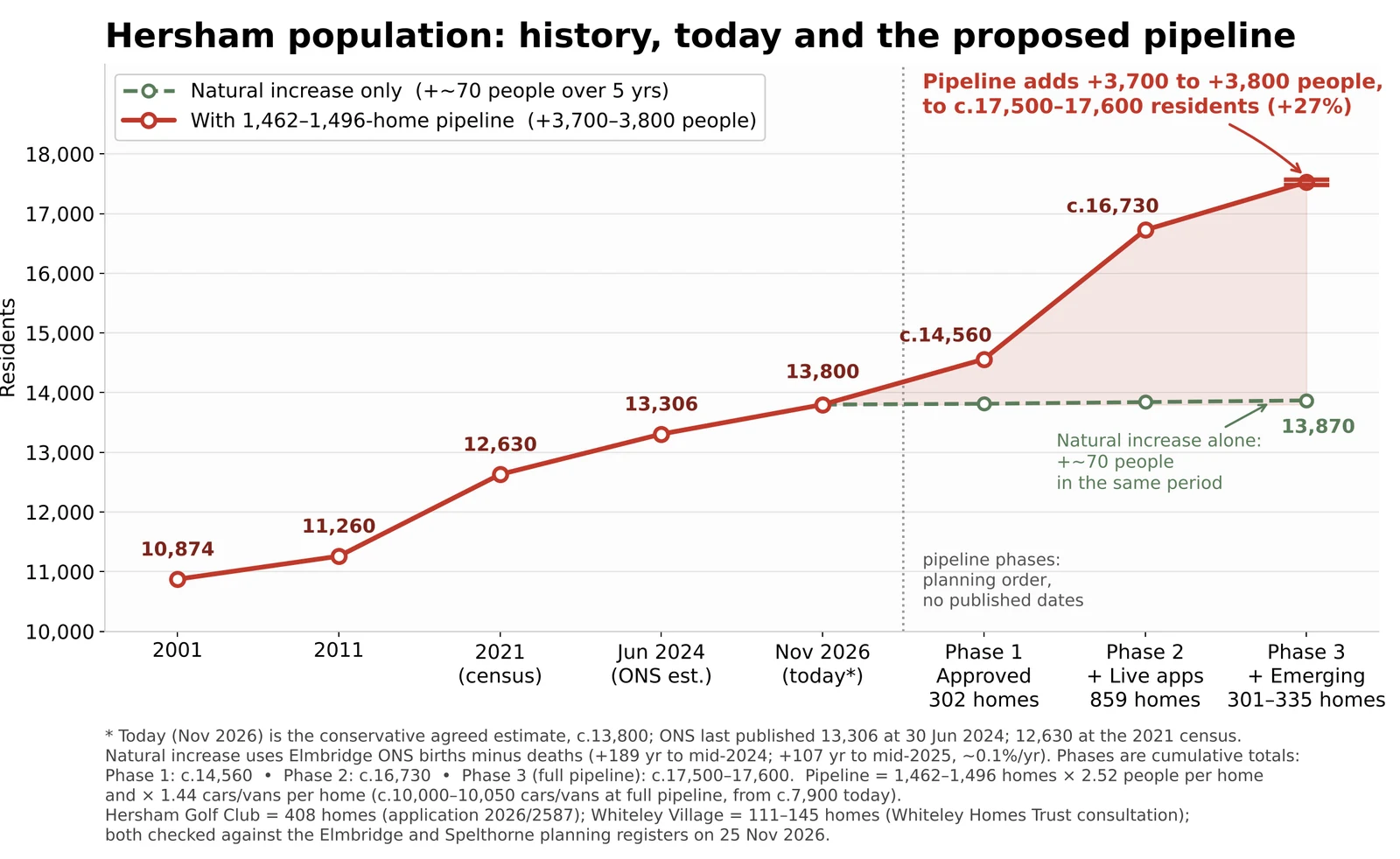
Exact model output: 17,484 to 17,570 residents.
Hersham's Built-up Area had 10,874 residents at the 2001 census. We estimate about 13,800 in November 2026, from ONS census and mid-year figures. If every home in the pipeline is built, the population would be between 17,484 and 17,570. That assumes each new home houses 2.52 people, Hersham's average household size at the 2021 census. Natural increase alone, births minus deaths, would add about 70 people over five years, to about 13,870.
Who decides the Golf Club application
How a cumulative question gets examined depends partly on who takes the decision. On 25 November 2026 the Elmbridge register listed application 2026/2587 for an officer delegated decision, with no committee date and a target decision date of 19 February 2027. That is the register at the time of checking. It can change. Under national regulations in force since 31 October 2026 (SI 2026/854), major applications are delegated by default, ward councillor call-in has been removed, and a referral to committee needs the agreement of the council's nominated member and nominated officer. Comments close on 28 December 2026. The Golf Club application review sets out the detail and links to the comment form.
What the Golf Club evidence says
The applicant's Planning Statement reports approximately 158 two-way vehicle trips in the morning peak and 160 in the evening peak, compared with reported Molesey Road flows of 1,314 and 1,222 vehicles respectively. The stated percentages of about 12% and 13% are arithmetically consistent. They do not establish that every trip uses the same road section or that delay rises by those percentages. These are applicant-reported figures, not traffic counts independently checked by this website. [S3, PDF p105, paragraph 11.95]
The statement says PICADY modelling for 2033 finds the Molesey Road/Assher Road and Molesey Road/secondary access junctions within capacity. It does not reproduce the numerical queues, delays or capacity results needed to examine that conclusion. A result for two junctions cannot establish performance throughout the surrounding network. [S3, PDF pp106-107, paragraphs 11.100-11.101]
The statement also identifies one significant adverse operational effect for people using the virtual footway on Assher Road. That finding deserves an explanation of who is affected, how often, and what additional protection is feasible. It should not be lost within a general claim that transport effects are acceptable. [S3, PDF p107, paragraphs 11.104-11.105]
Which assumptions need testing?
The applicant argues that affordable housing and access to sustainable transport make the trip estimate conservative. The supplied summary does not show tenure-specific rates or quantify a further reduction. That does not prove the assumptions are wrong. It means readers cannot yet test them. Ask for the selected comparison sites, their locations, survey dates, tenure and parking characteristics, and the precise reductions already included. [S3, PDF p105, paragraphs 11.96-11.98]
The proposed station link, crossings, bus-stop improvements and travel plan may change travel choices. Their contribution should be linked to funded delivery dates, measurable targets and action if targets are missed. A proposed measure is not evidence that a particular reduction has already been secured. EV charging changes vehicle technology; it does not by itself remove a vehicle journey. [S3, PDF p106, paragraph 11.99; community inference]
The reviewed summary does not identify the full committed-development schedule, background-growth factors or route assignments. These may exist in the separate Transport Assessment. We cannot say they were omitted from that assessment without seeing it.
Traffic in 5, 10 and 15 years
Using 2026 as the review year gives assessment horizons of 2031, 2036 and 2041. These are questions to test, not dates by which every scheme is assumed to be built. The applicant's 2033 design year should remain a separate comparison.
| Horizon | Road flows, queues and delays | Evidence needed |
|---|---|---|
| 2031, 5 years | Not yet established | Validated base surveys, first occupation/phasing, growth and route assignment |
| 2036, 10 years | Not yet established | Updated occupation scenarios and wider network model |
| 2041, 15 years | Not yet established | Longer-term land-use and travel-demand sensitivities |
For each road direction and peak period, a defensible calculation starts with a dated observed flow, applies an evidenced background-growth factor, and adds development traffic assigned to that movement. It subtracts displaced existing uses and avoids counting development both within a growth factor and again as a separate addition. Completed homes already occupied at the time of a survey will normally be represented in that survey, subject to validation. They must not simply be added again.
Each site's contribution depends on occupied homes, its own evidenced trip rate, travel mode, access and destination. Café and public open-space trips, deliveries and construction need explicit treatment where relevant. Golf Club's implied rate is not automatically suitable for retirement housing, flats or other schemes. Summing unassigned site trips does not give the number of vehicles on Molesey Road.
Matched scenarios should compare the future network without Golf Club, with Golf Club, and with other developments, using the same background assumptions. A separate sensitivity should test sustainable measures being late or achieving less than expected. Queues and delay require junction or network modelling because they do not grow in direct proportion to vehicle numbers.
Where the network needs examining
The places to start are the two proposed access junctions, Assher Road's shared carriageway and the affected parts of Molesey Road. The highway authority should explain the model boundary and whether nearby signal junctions, railway-related constraints, school peaks, pedestrian crossings and queues spilling back from elsewhere change the results. The tracker also identifies Turners Lane, Burwood Road and Mayfield Road as locations for scoping. Proximity alone does not prove that traffic from those sites uses the same junctions.
What about schools, GPs, water and drainage?
For school places, request age-specific pupil forecasts, catchments, spare capacity, funded expansion and delivery dates. For GP services, distinguish registered patients from appointment capacity, premises and staffing. Dental capacity needs its own evidence. Housing totals alone cannot establish a shortfall.
For water, wastewater and surface-water drainage, request the relevant providers' capacity responses, flood and drainage evidence, cumulative discharge assumptions, upgrade triggers and funding. For open space and ecology, examine access, long-term management and overlapping mitigation requirements. An unverified concern is not a measured deficit and should not be presented as one.
What evidence is still needed?
The priority is the full Bellamy Roberts Transport Assessment and appendices, Environmental Statement Chapter 8 and transport appendices, Surrey County Council's consultation response and scoping agreement, raw traffic counts, junction model inputs and outputs, and the committed-development schedule. After that, the site list needs reconciling against planning decisions and occupation dates. Any results should be published with their assumptions, so that residents and applicants can challenge them on the same basis.
Sources and revision policy
[S2] Application form PP-15236706, PDF pp4 and 11-15. [S3] Carter Jonas Planning Statement, October 2026, PDF pp104-108. Both are applicant documents on the Elmbridge register for 2026/2587. [L1] Existing live housing tracker and map retrieved 25 November 2026. Application reference: Elmbridge application 2026/2587, plans and documents. [R1] Elmbridge planning register entry for 2026/2587, checked 25 November 2026. [R2] Spelthorne planning register entry for 26/00822/OUT, checked 25 November 2026. [W1] Whiteley Homes Trust public consultation brochure.
Record each revision's date, source, changed figure and reason. Retain previous assumptions so that readers can see whether a conclusion changed because of new evidence or a different modelling choice.